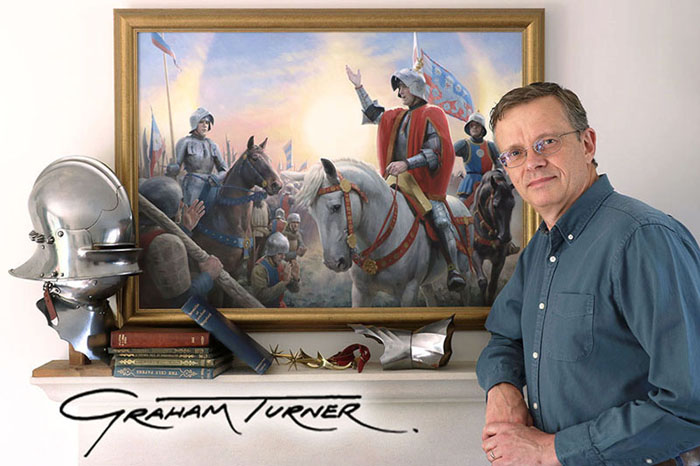
| | It is now 40 years since Graham Turner made the decision to go freelance and in that time he has built up a strong reputation for his paintings and prints amongst collectors worldwide. Born in 1964, as the son of Michael Turner he was obviously immersed in an atmosphere of art and motor racing from an early age, but it wasn`t until he was 16 that he developed a desire to embark on a similar career to his father. Despite the best efforts of a career adviser to persuade him otherwise, Graham was determined to follow this path and enrolled on a course in Art & Design at Amersham College. Two years working for a London design studio followed, before the decision to go it alone at the age of 20. 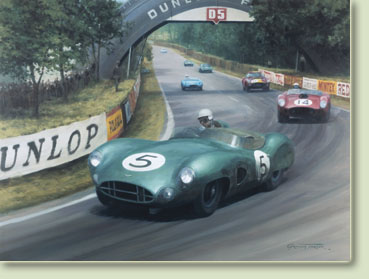 It was probably inevitable that Graham would find himself drawn towards the world of motor racing as an inspiration for his work and so it proved, with the first ten years of his freelance career spent almost entirely painting racing cars from all eras of the sport, for clients including drivers, teams and sponsors, as well as enthusiasts and collectors keen to record their racing memories. It was probably inevitable that Graham would find himself drawn towards the world of motor racing as an inspiration for his work and so it proved, with the first ten years of his freelance career spent almost entirely painting racing cars from all eras of the sport, for clients including drivers, teams and sponsors, as well as enthusiasts and collectors keen to record their racing memories.See Graham Turner's Motorsport Art - prints, cards and original paintings, in the Motorsport section of the STUDIO 88 ONLINE GALLERY |
| | In those early years Graham also competed as a rally driver, gaining the all-important first-hand experiences that give his work that additional realism, a philosophy that would later see him take up jousting in his bid to really understand his medieval subject matter (see below).He still retains a deep love for motor racing, and continues to paint dramatic scenes from the sport's history. However, realising the need to establish his own separate identity, not easy when following his father's footsteps so closely, he decided to forge his own path and branched out into a completely different sphere, a subject that had fascinated him since childhood - medieval history. | 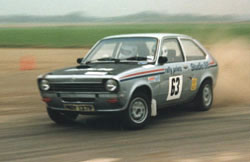 |
| | Medieval ArtGraham's first romanticised view of the medieval 'Knight Errant' was exhibited in 1992 and later published, alongside another with a similar theme, by a leading print publisher. These first steps into this new field were well received and, encouraged, his attention turned towards the reality of this turbulent period rather than the chivalrous ideal. The result was the 'Battle of Bosworth', the biggest canvas he had ever tackled, and this has now been followed by other large scale paintings of pivotal moments in the Wars of the Roses, many of which have been published as prints by Studio 88. See Graham Turner's Medieval Art - prints, cards and original paintings - in the Historical section of the STUDIO 88 ONLINE GALLERY To see how Graham approaches one of his complex medieval oil paintings, take a look at his PAINTING DIARY | 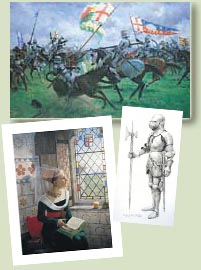 |
| THE WARS OF THE ROSESTHE MEDIEVAL ART OF GRAHAM TURNER - Signed by Graham TurnerSince first being inspired by a visit to Bosworth battlefield nearly 30 years ago, the Wars of the Roses has been a central theme of Graham Turner's artistic career, and this sumptuous book brings together over 120 of his paintings and drawings, many newly created, with supplementary images and a comprehensive and fascinating text that illuminates the complex, shifting course of events and the people who lived their lives through this tumultuous time.Order your signed copy now - CLICK HERE FOR DETAILS | 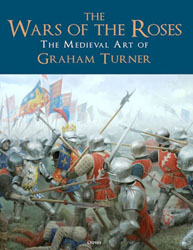 |
| 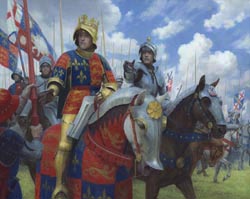 | Richard III at the Battle of BosworthNearly twenty years after he first painted the battle of Bosworth, Graham returned to the subject that had first inspired his passion for the Wars of the Roses and established him as a historical artist. He had just begun a new canvas showing Richard III at the battle when the incredible news broke that the possible remains of the king had been discovered in Leicester. Graham completed his painting during this exciting time, and was able to incorporate the new information this amazing discovery revealed about the king's appearance. He was honoured to be invited to speak at the press conference where the facial reconstruction of King Richard was revealed, and the painting was unveiled at an exhibition of his work held at the Bosworth Battlefield Heritage Centre later that year. Following on from that, he was asked to hold another large exhibition of his medieval art at the new Richard III Visitor Centre in Leicester, and this ran for over a year to great acclaim. Read more about this painting... |
| | The Battle of Agincourt2016 marked the 600th Anniversary of a pivotal event in British history, the Battle of Agincourt. To commemorate this, Graham Turner created what is probably his most ambitious painting yet, a large canvas showing Henry V in the thick of the fighting. Like his first Bosworth painting, Agincourt was accorded the honour of being displayed at the prestigious Wallace Collection in London, where Graham also spoke to a large audience about his work. | 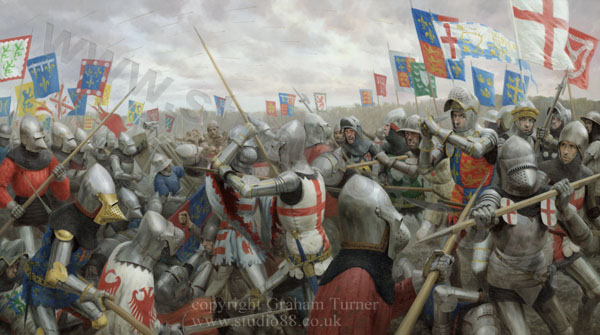 |
| 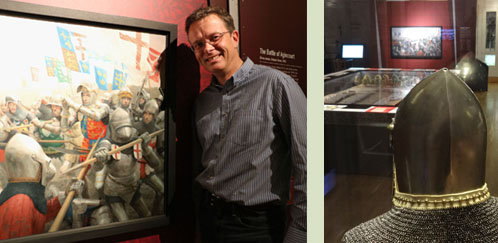 | CLICK HERE to find out more about the Agincourt painting, including many detail images and Graham's stage by stage guide revealing how he transformed a blank canvas into the finished oil painting.The original oil painting is now part of the Royal Armouries Collection, and on display at the Royal Armouries Museum in Leeds. |
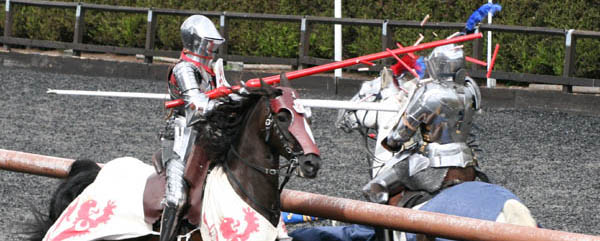
| | The Jousting ArtistGraham believes it is imperative to thoroughly research and understand the subject he is painting in order to be able to portray it accurately and convincingly. This desire to really understand his medieval subject matter saw him became involved in the adrenalin pumping medieval 'extreme sport' of jousting as a member of the group 'Destrier', and his experiences have had a profound effect on his paintings. He has jousted all over the country and abroad, at venues that include the Tower of London, Royal Armouries and the Historisches Museum in Bern, Switzerland, and in 2010 he fulfilled his greatest ambition as a jouster, by winning the Queen's Golden Jubilee Trophy at the Royal Armouries on his own horse, Magic. For the full story CLICK HEREHaving gained so many fantastic experiences and achieved so much more than he ever imagined possible in his decade of jousting, Graham decided to hang up his helmet at the end of the 2011 season. | 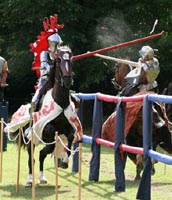 |
| | | | Osprey booksSince his first commission for Osprey Publishing back in 1996, Graham has now provided paintings for over 90 titles for this well known publisher of military books, covering historical periods from Ancient Rome, through the Middle Ages, Renaissance, the English Civil War, Napoleonic and Crimean Wars, to the First and Second World Wars. | 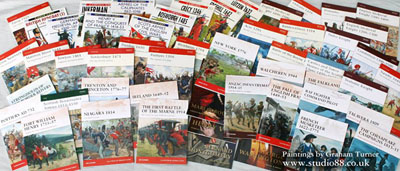 |
| 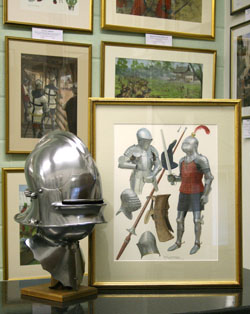 | On publication the original paintings are returned to Graham for resale, and many have found new homes with collectors. CLICK HERE FOR DETAILS of those that are currently available These paintings are priced considerably lower than Graham would usually charge, taking into account the fee that the publisher has paid for their use - a more affordable opportunity to acquire a unique piece of original art by Graham Turner, a painting that is 'immortalised' in print. |
| | Aviation ArtAware that he already overlapped his father's work in the field of motorsport art, Graham resisted trespassing into his aviation art realm until 2011, when he exhibited "Steady Boy" at the Guild of Aviation Artists London Exhibition. The original was snapped up at the opening, and was voted the most popular work in the exhibition by the public, winning it the Roy Nockolds Trophy. His two paintings exhibited the following year also sold, and his success continued with his 2013 exhibit - Into the Hands of Fate - which could have sold several times over. Into the Hands of Fate was also awarded the Cross and Cockade prize for the best First World War aviation painting, the Roy Nockolds Trophy (voted for by the public), and was runner up for the two top awards - the Aviation Painting of the Year and Flypast Fellows Award for Excellence. Suitably inspired and elected a Full Member of the Guild, he continues to successfully exhibit with them and create new paintings that reflect his interest in the men and machines of this early period in aviation history.CLICK HERE to see Graham Turner's Aviation Art - Original Paintings, Prints and Cards. | 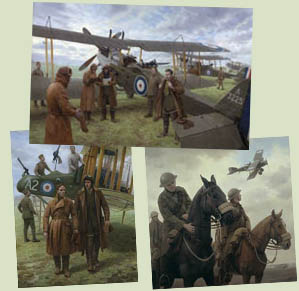 |
| 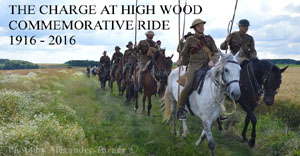 | First World War ArtIn July 2016 Graham Turner took part in a two-day commemorative ride on the Somme battlefield, in full cavalry kit, retracing the steps of the only cavalry action to take place during the battle, the charge at High Wood, 14th July 1916.CLICK HERE to see details of Graham's First World War paintings and prints, and to read an article he has written for 'Battlefield', the magazine on the Battlefields Trust, about the charge and recounting his own experiences a century later. |
| 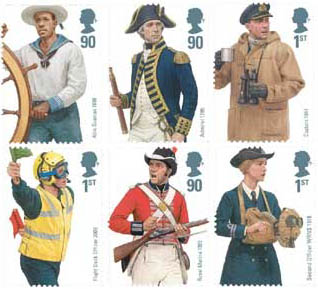 | Royal Mail Military Uniform Stamps
In 2007, Graham Turner was commissioned to paint a set of six stamp designs for the Royal Mail, featuring British Army uniforms from the 17th century to the present day, and this was followed in 2008 by a set showing the development of uniforms in the Royal Air Force, and in 2009 by the final set depicting the Royal Navy (pictured). |
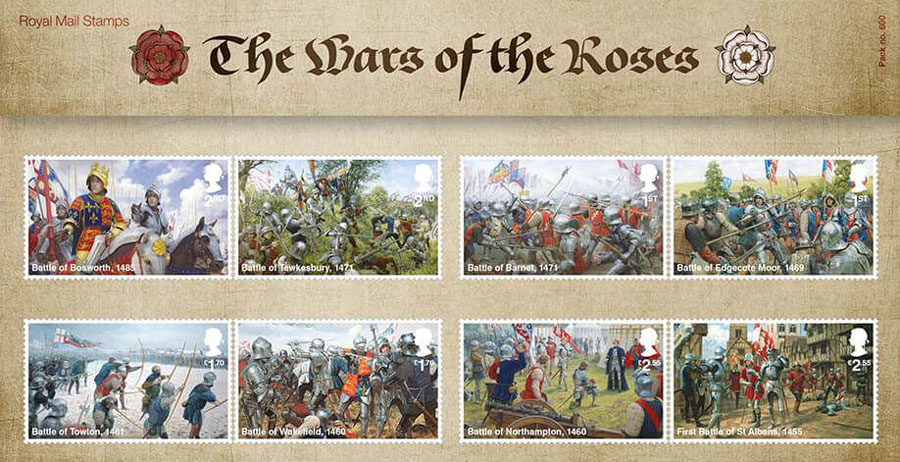
| | WARS OF THE ROSES STAMPSOn 4th May 2021, the 550th anniversary of the Battle of Tewkesbury, the Royal Mail issued a set of eight stamps commemorating the Wars of the Roses, each one featuring one of Graham Turner's paintings. Graham was delighted - and honoured - that his work was chosen for this prestigious project, and the recognition it confers of his dedication over the past twenty-five years in bringing to life this turbulent period in history with his carefully researched paintings.The battles featured are ST. ALBANS 1455, NORTHAMPTON 1460, WAKEFIELD 1460, TOWTON 1461, EDGCOTE 1469, BARNET 1471, TEWKESBURY 1471, and BOSWORTH 1485. |
| | | | |
|